
Block 03 of 11 · Report SSRC-TER-LG-01 · Version 2.2
Is seismic activity increasing? Trend and region
Homogeneous analysis of the ComCat catalogue and activity in Colombia, Brazil, Guyana and the Eastern Caribbean.
7. Is seismic activity increasing?
| CENTRAL IDEA. The answer depends on the scale: local activity abruptly increased due to the doublet and its aftershocks; no equivalent general increase is demonstrated across the entire regional environment or globally. |
|---|
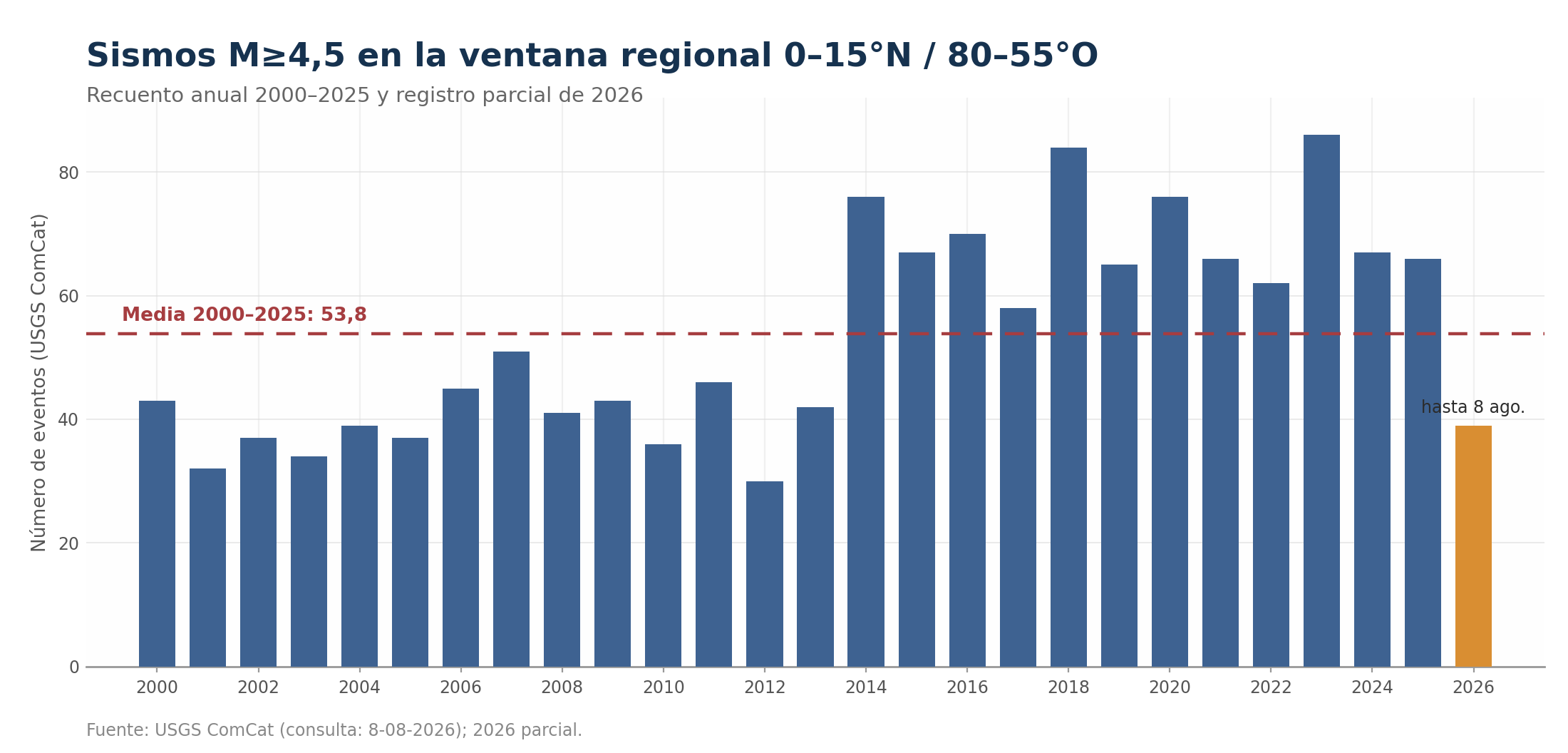
Figure 8. Annual ComCat M≥4.5 count. Broad regional window; 2026 is partial. Query and calculation: August 8, 2026.
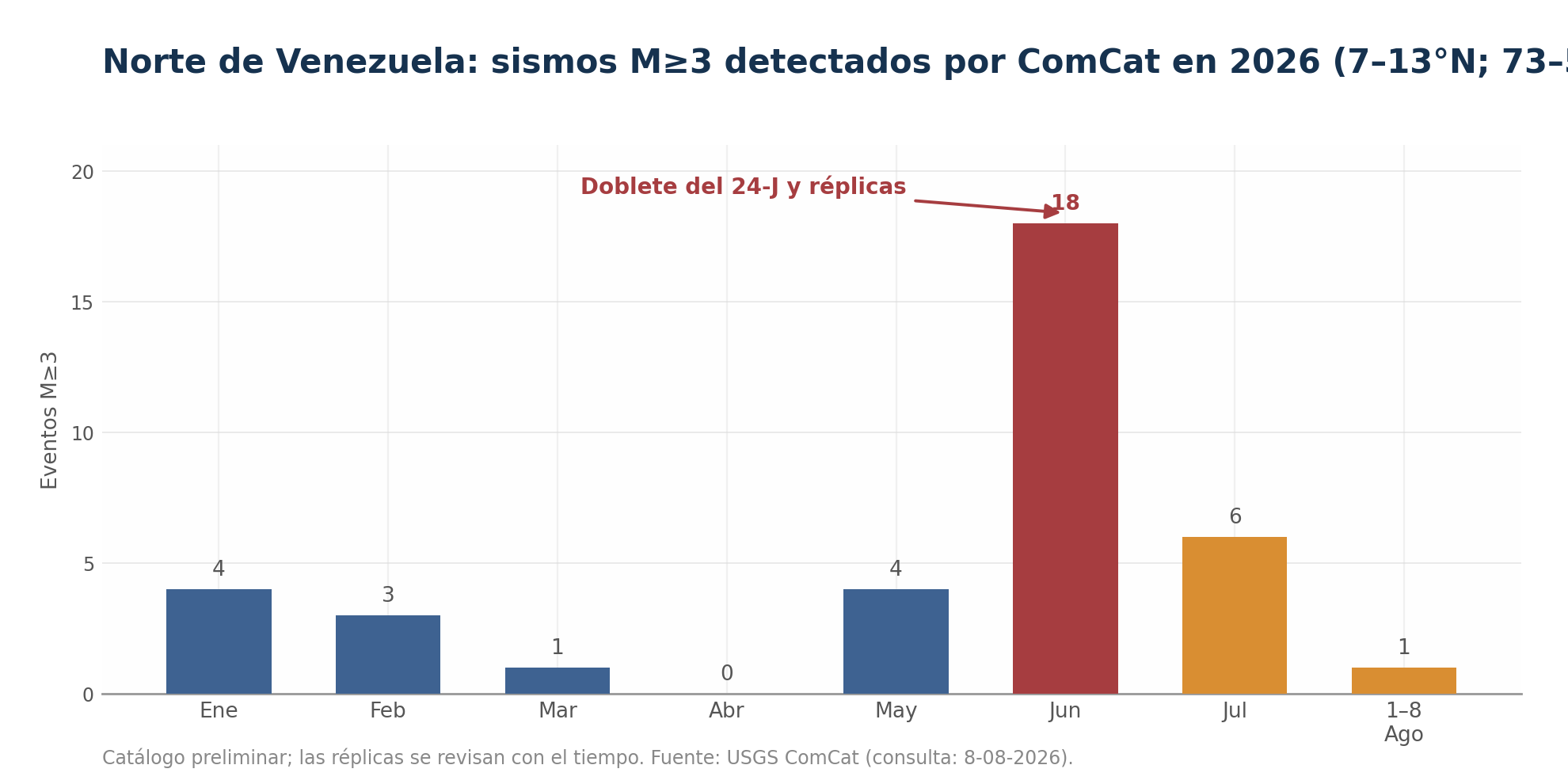
Figure 9. Monthly ComCat M≥3 count in northern Venezuela (7-13°N; 73-59°W). Local catalogues detect many more small events.
An aftershock sequence produces hundreds or thousands of small earthquakes and a visible peak in any local catalogue. Stating that "there are more earthquakes" is correct for that area and period. The error occurs when extrapolating this to continents or the planet without a homogeneous catalogue and a completeness threshold.
Modern networks record events that previously went unnoticed. The USGS locates about 20,000 global earthquakes per year and explains that instant communication increases public perception. A catalogue with more stations contains more small earthquakes even if the physical rate does not change [18]. To study trends, a threshold is set—for example, M≥4.5—which the global network detects more uniformly.
In the window 0-15°N and 80-55°W, the 26 full years 2000-2025 yield between 29 and 86 M≥4.5 events per year, with an average of 55.6. The 39 accumulated up to August 8, 2026, would, by simple annualisation, be equivalent to approximately 64: within the observed variability. Annualisation is not a forecast; it only contextualises the partial data.
In contrast, for northern Venezuela and M≥3, the jump in June is evident. ComCat captures only a portion of the small aftershocks; FUNVISIS, due to local density, reports many more. Both catalogues serve different objectives and capabilities and should not be mixed to calculate a trend without homogenisation.
A large earthquake can transfer stresses and activate nearby faults or distant seismicity under favourable conditions, but this does not imply an unlimited chain reaction. The highest probability is concentrated in the rupture zone and decreases with distance and time. Aftershock forecasts express conditional probabilities, not certainties.
| VERDICT. Unequivocal local increase and aftershock hazard: yes. Sustained regional trend above historical variability: not demonstrated with the homogeneous data analysed. Global increase: not supported by USGS. |
|---|
8. Activity in Colombia, Brazil, Guyana and the Eastern Caribbean
| CORE IDEA. Sharing a border does not imply sharing the same seismic source. Each country must be interpreted according to its tectonic regime, observation network, and vulnerability. |
|---|
Colombia has one of the most complex contexts: Nazca subduction beneath South America, Caribbean interaction, the Northern Andes block, and active crustal faults. Its frequent seismicity and Andean volcanoes are not a simple extension of the Venezuelan doublet. Earthquakes in northeastern Colombia can be related to shared structures of the Andes and the border, while those in the Pacific primarily respond to subduction.
Brazil and Guyana are located in the interior of the South American plate and, on average, have lower hazard than the Andean-Caribbean strip. However, "intraplate" does not mean "without earthquakes". Old faults can be reactivated by the stress field, and waves from large Venezuelan events can be felt at great distances, especially in tall buildings or on soft soils.
Trinidad and Tobago are a direct part of the deformed belt of the southern Caribbean. The UWI-SRC describes approximately 40 annual M≥2.1 events in the Gulf of Paria and Paria Peninsula area, in addition to seismicity to the north, east, and within Trinidad. Depths vary from shallow to over 150 km [9]. This necessitates distinguishing between crustal sources, capable of intense localised shaking, and deep earthquakes, widely felt but often less damaging at the surface.
In the Lesser Antilles, the South American plate subducts beneath the Caribbean plate. Here, earthquakes from the plate interface, earthquakes within the descending plate, and volcanoes of the arc coincide. UWI-SRC reminds us that seismic activity in the Eastern Caribbean has continued throughout the centuries; what has clearly increased is exposure: more population, concrete buildings, coastal landfills, and tall hotels.
Aruba, Curaçao, and Bonaire are located opposite Venezuela and can feel earthquakes from the coastal strip. Their risk depends on distance, soil, building design, and the continuity of ports, desalination, energy, and communications. Regional cooperation must share data and tsunami protocols, not assume that a national alert covers all islands.
| Area | Dominant regime | Risk assessment |
|---|---|---|
| Northern Venezuela | Caribbean-South American strike-slip and deformation | High seismic hazard; faults close to large cities. |
| Andean Colombia | Nazca subduction + crustal faults + Caribbean | High seismicity and volcanism, with diverse sources. |
| Interior Brazil | Intraplate | Lower rate, not zero; moderate events and distant perception. |
| Guyana | Shield/intraplate | Generally low hazard; local vulnerability still relevant. |
| Trinidad-Paria | Diffuse boundary and deep subduction | Shallow and deep earthquakes; strong regional connection. |
| Lesser Antilles | Subduction and volcanic arc | Seismic, volcanic, and tsunami threat. |