
Part III of 6 · SSRC-INF-IIFF-v2.0 Report
What the headlines and aerial means say
Risk communication, air and technology applied to extinction.
05 · What the headlines say
Inventory is not availability
Each campaign opens with a resource figure, and that figure is read as if it were a promise of simultaneous presence anywhere in the country. It is not. There are four distinct magnitudes: the existing fleet, the planned deployment, daily availability, and the aircraft actually assigned to a specific fire.
The 2026 state deployment announces 56 aircraft, complementary to the resources of the autonomous communities; within this deployment, up to 10 amphibious aircraft are foreseen Canadair of the FOCA type (external link, opens in a new tab) y 5 ALFA medium amphibious aircraft (external link, opens in a new tab). These are specialized resources, with qualified crew and their own loading, refueling, and maintenance cycles: calling them "small planes" poorly describes what they do and what they cost.
The existence of 14 Canadair amphibious aircraft in the fleet does not imply 14 operational every day. Nor can those not deployed be automatically classified as broken down: it could be scheduled maintenance, inspections, modernization, reserve, or crews at rest. The renewal of the state amphibious fleet (external link, opens in a new tab) is also managed through an interdepartmental agreement, with entries and exits from service over time.
Spain has been operating the Canadair system since 1971, which gives the country long experience with this type of asset; this does not mean that the current aircraft are fifty years old, because the fleet has been renewed and modernized.
And above all there is simultaneity: when several incidents coincide, availability is distributed. Distance to base, flight time, loading cycles, crew relays, maintenance, and uncommitted reserve determine how many assets arrive and how much they can sustain the effort. 2025 statistical fire forecast (revised) (external link, opens in a new tab) allows us to determine the magnitude of the problem, not the availability on a specific day.
Editorial review
An inventory published without availability or simultaneity does not allow for auditing the system's real capacity.
Pregunta de transparencia: Can the number of deployed, available, and under maintenance assets, along with the number of simultaneous fires attended, be published daily and in a reusable format?
Visual family for chapter 05
Four visuals: the funnel from inventory to fire front (V13), the layers of human force (V14), the comparison of liters per pass for aerial assets (V14.b), and the historical continuity of extinction work, from the Roman bucket to the drone swarm (V14.c).
V13 · Auditable visual
From inventory to fire front
Message: A counted resource is not yet an available resource: between inventory and the fire front there are successive filters.
Filter 1
Inventory
Aircraft and vehicles existing in the fleet, regardless of where they are today.
Filter 2
Deployed
Resources located at bases according to the planned setup for the campaign.
Filter 3
Available today
Excluding scheduled maintenance, breakdowns, inspections and crew on rest.
Filter 4
Close to the fire
Within a useful flight or travel time for the incident.
Filter 5
Assignable
Decided by command between simultaneous fires and protection priorities.
Filter 6
Sustainable for several shifts
With relays, loading cycles, refuelling and uncommitted reserve.
The holder has an inventory account; intervention requires availability.
What it demonstrates — and what it does not
What it demonstrates
That successive filters exist —deployment, daily availability, distance, assignment and shift-based sustainment— between the inventoried fleet and the resources acting on a specific fire.
What it does not demonstrate
It does not quantify how many resources pass each filter on a given date, nor does it allow a non-deployed resource to be classified as broken down.
- Source
- MITECO, FOCA, ALFA and TANGO aerial resources; Interdepartmental Agreement MITECO–Defense for the improvement of the state amphibious aircraft fleet.
- Editorial date
- Web edition v2.0 · August 4, 2026
- Level of evidence
- A
Alternative text: Funnel with six decreasing stages: inventory, deployed, available today, near the fire, assignable by command, and sustainable for several shifts. Each stage describes the filter that reduces the number of truly deployable resources.
V14 · Auditable visual
The force that doesn't fit in a headline
Message: The headline counts people; the fire demands accredited, equipped, rested and nearby teams.
- 1
Annual staff
Stable personnel with continuous training and knowledge of the territory.
- 2
Seasonal reinforcement
Additions linked to the high-risk season.
- 3
Accredited volunteering
Defined functions, training, PPE, communications, insurance and written agreement.
- 4
Daily availability
Excluding rest periods, leave, sick leave, and ongoing training.
- 5
Reliefs
Shifts that allow an intervention to be sustained for more than one day.
- 6
Uncommitted reserve
Free capacity for a second or third simultaneous fire.
What it demonstrates — and what it does not
What it demonstrates
That actual human capacity depends on accreditation, equipment, daily availability, reliefs and reserve, and not just the announced total.
What it does not demonstrate
It does not provide staff figures per autonomous community nor does it allow adding volunteers and professional staff as the same capacity.
- Source
- MITECO, ground resources and BRIF; Law 17/2015 on the National Civil Protection System; Cabildo de Tenerife, island operation and Operation Prometeo 2026.
- Editorial date
- Web edition v2.0 · August 4, 2026
- Level of evidence
- B
Alternative text: Six layers of personnel: annual staff, seasonal reinforcement, accredited volunteers, daily availability, relief and uncommitted reserve; each layer explains what condition must be met for that personnel to count as real capacity.
V14.b · Auditable visual
Litres per pass: what an aerial asset compares and what it does not
Message: The volume that fits in a tank does not measure the capacity of the device: it is measured by cadence, distance to water and coordination with the terrain.
Comparison of nominal capacity per discharge. The bar is proportional to the volume and takes as reference the 20,000 litres of the containerized kit mounted on a tactical transport aircraft.
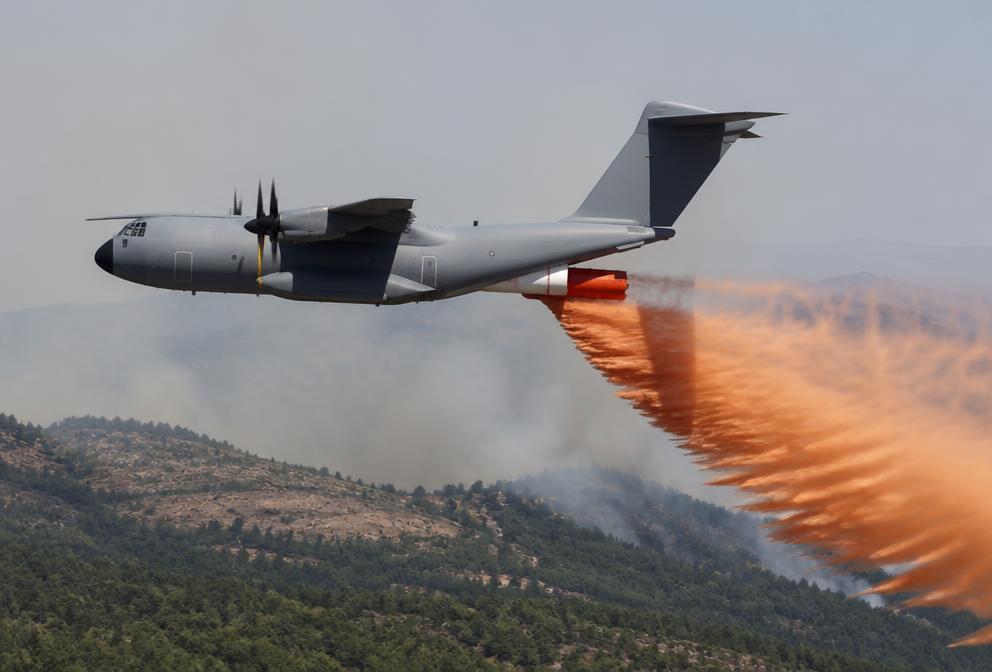
01 · Tactical four-engine · removable kit (roll-on / roll-off)
Transport aircraft with containerized kit
0liters / pass
Large volume per pass, but requires a long runway, ground refilling, and a flight window compatible with smoke and terrain.
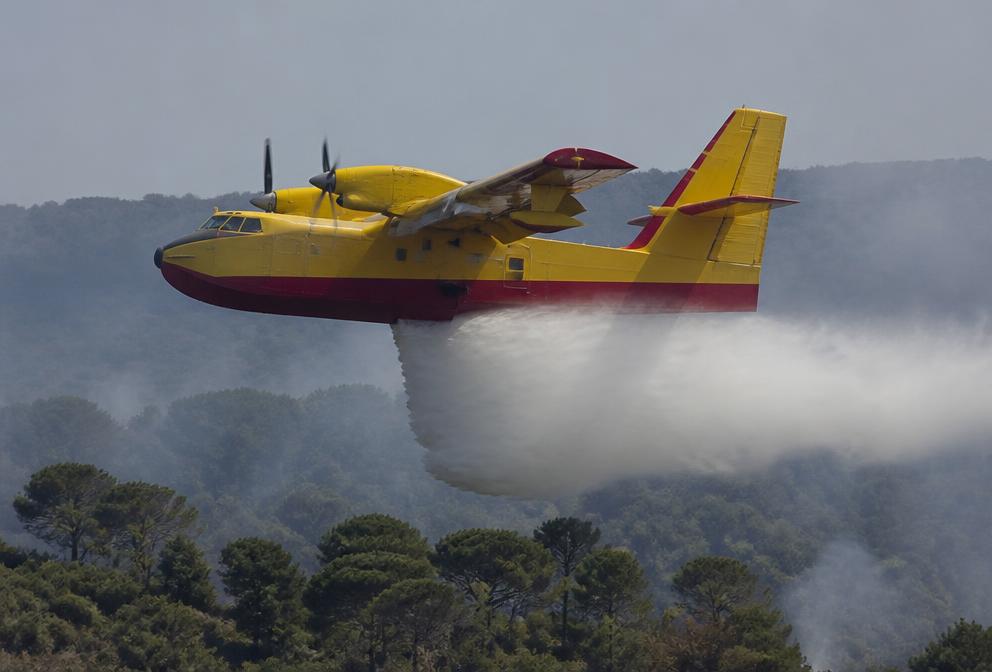
02 · Twin-engine amphibious aircraft type CL-415 · water loading
Amphibious firefighting aircraft
0liters / pass
Lower volume per discharge and much faster cadence: refills in nearby body of water and repeats cycles in a few minutes.
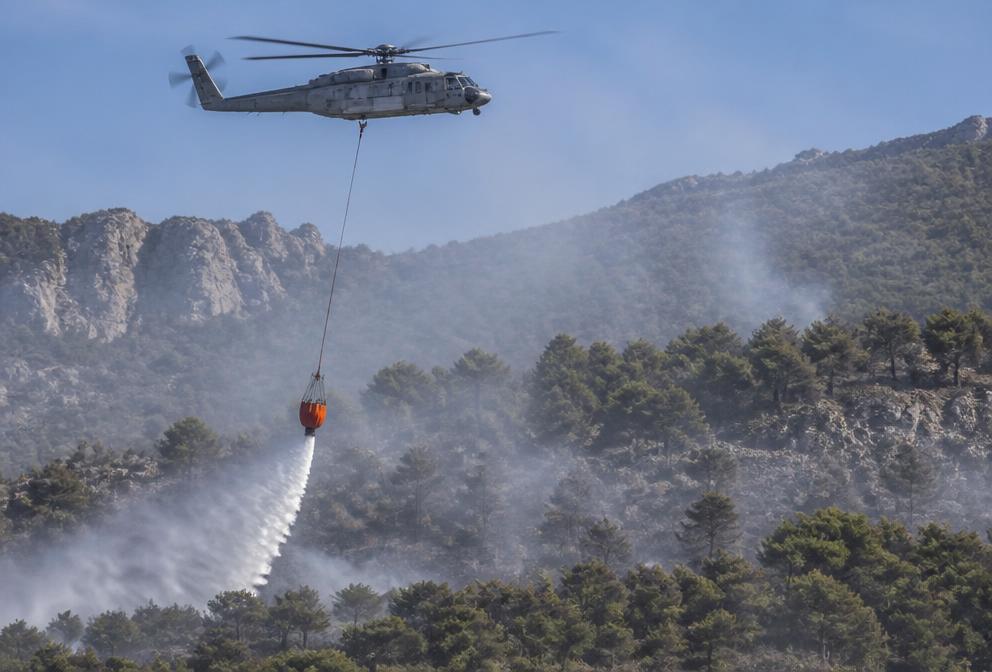
03 · Ventral tank or helibucket · loads at water point
Heavy helicopter
0liters / pass
1,200 – 4,500 depending on model
Precision over the critical point and direct support to brigades: it is the asset that sustains ground maneuver.
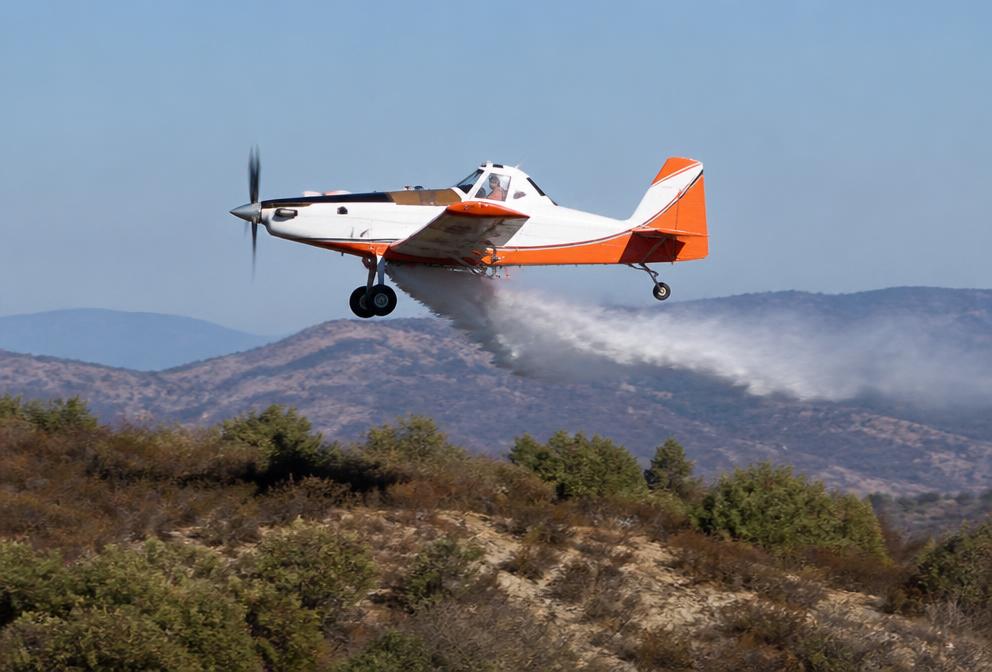
04 · Single-engine aircraft type AT-802F · loads at aerodrome or base
Ground-loading aircraft
0liters / pass
Fast, cheap per hour and very useful in initial attack; calling it a "light aircraft" obscures its real role in the first half hour.
Correct reading
Four discharges of 6,137 liters with quick water reloading deliver more water over the front, and with greater continuity, than a single discharge of 20,000 liters with base reloading. The useful indicator is not the maximum literage, but the liters effectively delivered per hour on the point that defines the perimeter, and with what ground support they are consolidated.
The endowments of retardant or suppressant agent and their dosages are declared by approved product and are not attributed here to any commercial brand: any performance comparison between agents remains pending documented testing from an official source.
What it demonstrates — and what it does not
What it demonstrates
What it does not demonstrate
- Source
- Manufacturer's technical specifications (containerized extinguishing kit for tactical transport aircraft; CL-415 amphibian; AT-802F single-engine; helibuckets and ventral tanks) and MITECO's public catalog of aerial resources.
- Editorial date
- August 4, 2026
- Level of evidence
- B · Capacidades nominales de catálogo
Alternative text: Infografía V14.b: comparación de capacidad de descarga por pasada de cuatro medios aéreos, ilustrada con cuatro fotografías. Avión de transporte cuatrimotor con kit contenedorizado de extinción: hasta 20.000 litros por descarga. Anfibio de extinción tipo Canadair CL-415: 6.137 litros por descarga, con recarga en agua en pocos minutos. Helicóptero pesado con depósito ventral o helibalde: entre 1.200 y 4.500 litros según modelo. Avión de carga en tierra tipo Air Tractor AT-802F: 3.100 litros por descarga. Barras proporcionales al volumen y aviso de que el volumen por pasada no mide la eficacia del dispositivo.
V14.c · Auditable visual
Two thousand years of the same task: from the Roman bucket to the swarm
Message: The delivery vector changes and personnel exposure decreases; the three tasks that decide the fire do not change: cooling the edge, breaking fuel continuity and consolidating the perimeter.
Four scenes separated by twenty centuries and all available technology. The sequence is not to be read as a scale of progress where the new nullifies the old, but as layers added to a task that has not changed: the team maintaining the perimeter still decides an extreme fire.
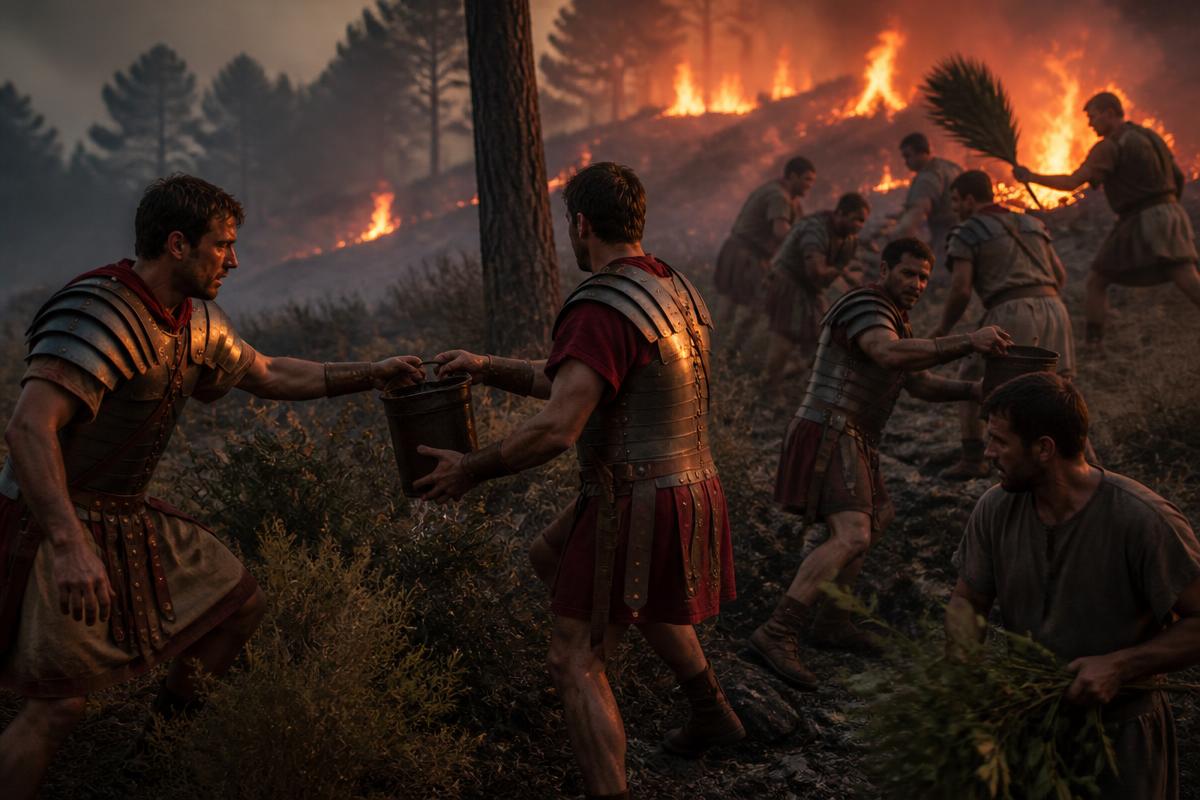
01 · 1st Century · Rome
Bucket chain and green branches
- Delivery Vector
- Hand bucket in human chain + green foliage as fire beater
- Invariant Task
- Cool the flame edge and break fuel continuity.
- What it provides
- The vigiles introduce what remains the core of the trade: prior organization, shifts, water supply chain, and direct attack on the flame edge with hand tools.
- What it doesn't solve
- Minimum flow, no reach in crowns, and total operator exposure to the fire front.
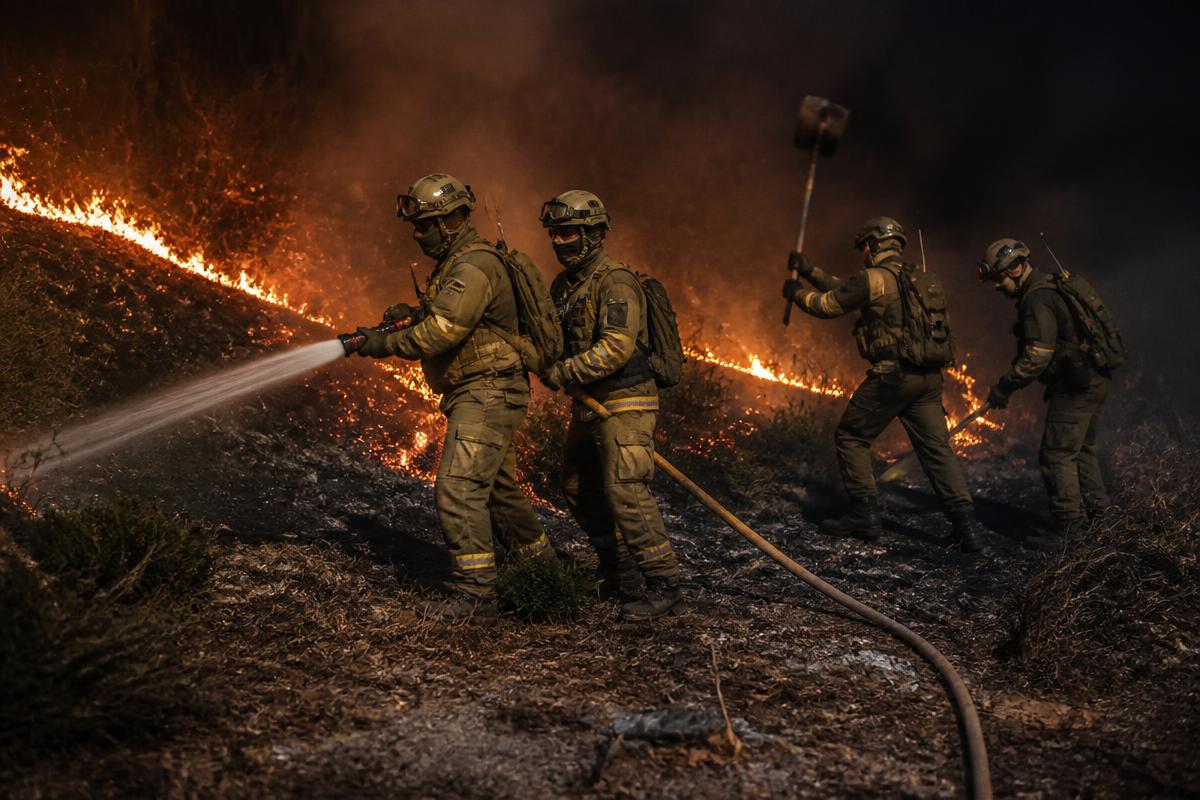
02 · Today · Spain
Hose and fire beaters on the flank
- Delivery Vector
- Pressurized hose line + fire beaters + line tool
- Invariant Task
- Cool, beat and consolidate the perimeter meter by meter.
- What it provides
- Sustained pressure and flow, approved personal protection, single command, and ability to work at night, when intensity decreases and ground maneuver gains a useful window.
- What it doesn't solve
- Depends on water logistics and access; in crown fires with coupled wind, direct attack becomes unviable and retreat to a defensible line is necessary.
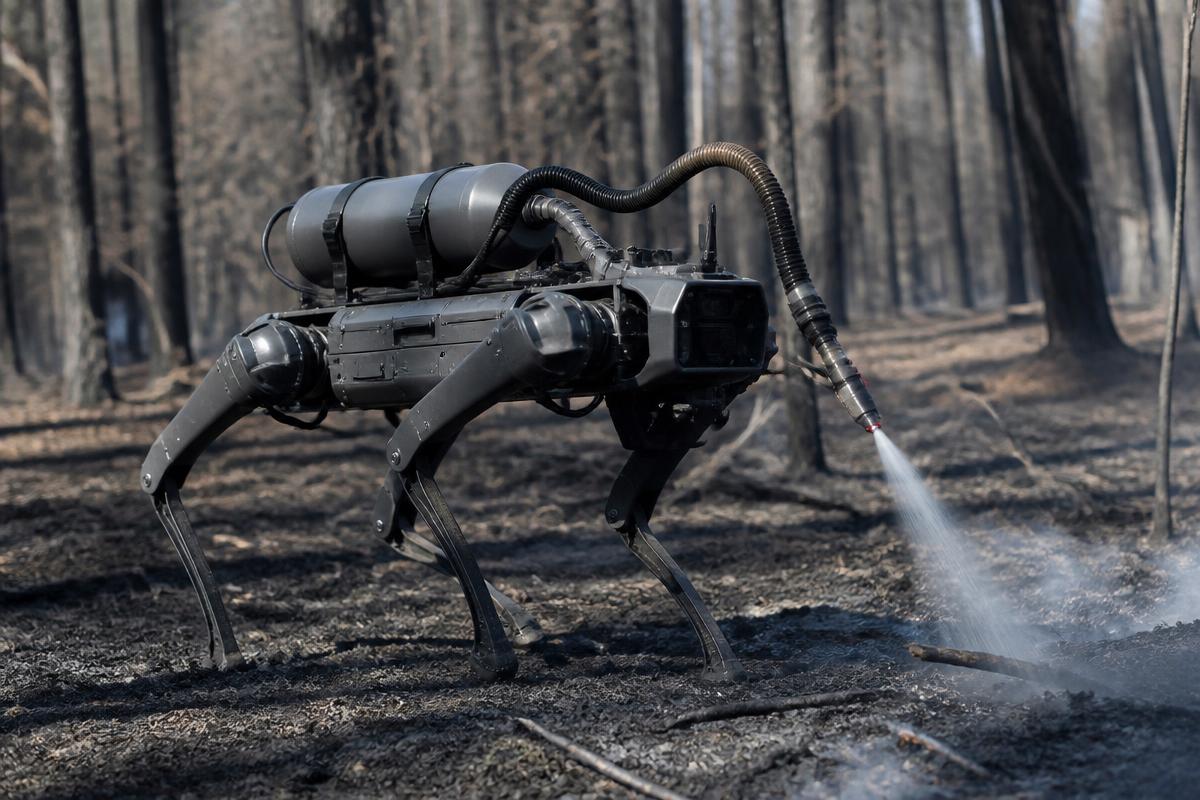
03 · Trial · Terrestrial robotics
Quadruped with dorsal tank and nozzle
- Delivery Vector
- Teleoperated quadruped platform with suppressant agent tank and flexible nozzle
- Invariant Task
- Cool hot spots and monitor reignition after the front passes.
- What it provides
- Removes the operator from the exposure zone during finishing, liquidation, and ember monitoring tasks, and maintains sensors in unstable terrain, with dense smoke or risk of tree fall.
- What it doesn't solve
- Very reduced autonomy and transported volume compared to a hose lay: it is a finishing and reconnaissance tool, not for attacking an active front.
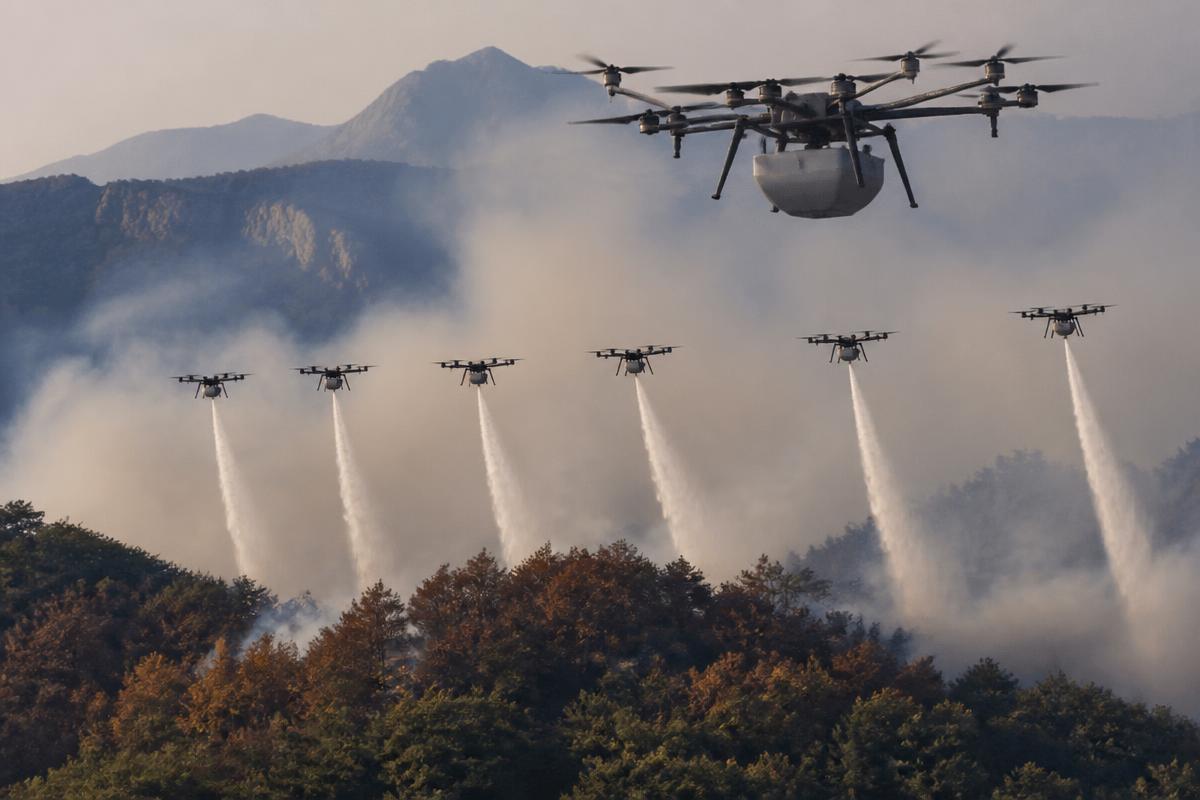
04 · Trial · Unmanned aircraft
Light swarm and mother drone
- Delivery Vector
- Swarm of low-load multirotors + larger capacity mother platform
- Invariant Task
- Deliver water on the point that defines the perimeter, with cadence.
- What it provides
- Distribution of effort in many small and continuous passes, night flight and in degraded visibility, and permanent thermal observation over the front without risking crew.
- What it doesn't solve
- Very small individual load and dependence on a nearby base, airspace management and coordination with manned assets: it does not replace an amphibious aircraft or ground work.
Correct reading
The Roman with a green branch and the drone swarm do the same thing on two different scales: cooling and breaking continuity. What technology can truly change is not the power of the final blow, but the detection time, the delivery cadence, reignition surveillance, and the number of people exposed to the front. A system that incorporates robotics or unmanned aircraft without trained personnel, fuel planning, and unified command keeps the fundamental problem intact.
The scenes are recreations and illustrations generated for this report, not documentary photographs of specific operations: they are used as conceptual support and not as proof of real deployment.
What it demonstrates — and what it does not
What it demonstrates
What it does not demonstrate
- Source
- Historical sources on the vigiles and Roman fire organization; doctrine and material of emergency military units and regional extinguishing services; public documentation of trials with terrestrial robotic platforms and unmanned extinguishing aircraft.
- Editorial date
- August 4, 2026
- Level of evidence
- C · Comparación conceptual con ensayos no consolidados
Alternative text: Infografía V14.c: cuatro escenas de extinción ordenadas por época para mostrar qué cambia y qué no. Escena 1, siglo I: soldados y vigiles romanos pasan cubos de agua en cadena y baten las llamas con ramas y hojas de palma en una ladera mediterránea. Escena 2, presente: militares de la unidad de emergencias españolas avanzan con línea de manguera y batefuegos sobre el flanco del incendio, de noche. Escena 3, ensayo actual: robot cuadrúpedo con depósito dorsal de agente supresor y lanza flexible mojando combustible en reignición sobre suelo quemado. Escena 4, ensayo actual: enjambre de drones ligeros descargando agua en formación sobre una cresta con humo, apoyado por un dron nodriza de mayor capacidad. El bloque final resume que la tecnología cambia el vector de entrega y la exposición del personal, pero no las tres tareas invariantes: enfriar, batir y consolidar el perímetro.
Closing of chapter 05
If the count of assets requires nuances, the announcement of technology requires even more: it is important to distinguish what is already flying from what is still being tested.
Continued on 06 · Aire y tecnología
06 · Air and technology
Innovating is not announcing: it is testing, integrating, and sustaining
It is important to separate three things that public debate mixes: accredited operational technology, supervised pilot project, and research and development. Announcing a tool does not incorporate it into the system; incorporating it requires testing, integration with command, training, maintenance, and sustained funding.
In the air, assets are not equivalent: the amphibious FOCA (external link, opens in a new tab), the ALFA medium amphibious aircraft (external link, opens in a new tab) and the TANGO ground loaders (external link, opens in a new tab) have different missions, load capacities, and cycles, and their selection depends on the incident, available water, and distance.
Modular discharge systems from transport aircraft, such as RALS on A400M, must be presented as experimental or potential capabilities: not as operational Spanish assets, unless there is unequivocal official source accrediting it. Nor is it appropriate to state that another country has used it operationally if it is not proven.
With drones, two very different uses must be distinguished. Observation, thermal detection, and incident monitoring are already available and integrated with separation protocols from manned aircraft. Heavy discharge is under development. Unlimited operation cannot be promised in strong winds and dense smoke, nor automatic coexistence with manned assets in the same airspace.
Private pools and other water reservoirs are a potential resource, not a default available resource. To qualify as a reservoir, they require prior registration, safe access for the asset, sufficient quality and volume, a compatible intake, an indemnity scheme, and, above all, a command decision. It is not true that any helicopter can fill from any pool.
Regarding alternative agents to water, including Ecofire, this report treats them as candidates: they require independent testing, evaluated cost at scale, environmental and operational compatibility, and authorization from the competent authority. We do not repeat commercial claims such as "30–40 times," "does not evaporate," "can be drunk," or "fire does not pass through it" as facts.
Water remains essential: it cools by heat absorption and by vaporization, and that vaporization is part of the extinguishing mechanism. The fact that a fraction evaporates does not automatically make water an ineffective resource.
Editorial review
Purchasing at scale before independent evaluation shifts the technical risk to the device and to the public budget.
Propuesta: Publish, for each incorporated technology, its maturity level, test results, sustainment cost, and operational conditions under which it can be used.
Visual family for chapter 06
A visual with two parts: the technological maturity ladder and the decision table between water, authorized retardant, and alternative agent under testing (V9).
V9 · Auditable visual
Technological maturity ladder
Message: Innovating is not announcing: each technology must be placed at its true level of maturity before being counted as a capability.
- 4
Accredited operational
Evidence AFOCA amphibious aircraft and ALFA medium amphibious aircraft, transport and extinguishing helicopters, TANGO ground-loading aircraft, thermal detection and aerial surveillance integrated into the system.
- 3
Supervised pilot
Evidence BObservation and detection drones with separation protocol for manned aircraft; analysis and incident monitoring tools in limited deployment.
- 2
Research and development
Evidence CHeavy-lift drones, modular discharge systems from transport aircraft —RALS type on A400M— and support robotics in approach.
- 1
Proposal pending trial
Evidence DCommercially presented water alternative agents, including Ecofire, and massive uses of private water reserves.
Decision table: water, authorized retardant and alternative agent under trial
| Option | Function | Advantage | Limit | Requirement |
|---|---|---|---|---|
| Water | Cools by heat absorption and vaporization; moistens fuel. | Available, known, without specific authorization and compatible with all means. | High consumption, loading logistics and loss due to evaporation and drift. | Registered, accessible and verified water points. |
| Authorized retardant | Modifies combustion and prolongs the effect on treated fuel. | Maintains effect after discharge and allows working on defense lines. | Regulated conditions of use and application; not interchangeable with water. | Authorized product, dosage and registration according to applicable regulations. |
| Alternative agent under trial | Performance declared by the manufacturer, pending independent verification. | Potential to reduce water consumption if trials confirm it. | No independent evaluation published, large-scale cost and environmental and operational compatibility to be determined. | Independent trials, authorization and decision by the competent service before massive purchase. |
The table does not classify products as toxic or harmless generically: evaluation corresponds to the competent authority and independent tests.
What it demonstrates — and what it does not
What it demonstrates
That accredited operational technologies, supervised pilots, ongoing developments and proposals without independent verification coexist in the public debate.
What it does not demonstrate
Does not accredit specific performance of any commercial product, does not anticipate adoption deadlines, and does not generically disqualify any line of research.
- Source
- MITECO, FOCA, ALFA and TANGO equipment sheets; MITECO–Defense interdepartmental agreement on the state amphibious aircraft fleet.
- Editorial date
- Web edition v2.0 · August 4, 2026
- Level of evidence
- B
Alternative text: Four-level technology readiness ladder with its evidence level: accredited operational with level A, supervised pilot with level B, research and development with level C, and proposal pending testing with level D, each with declared examples.
Close of chapter 06
No single technology alone sustains a campaign: behind every asset are people with physical limits and rights, and that is the next layer of the system.
Continued on 07 · Quienes sostienen la respuesta