
Part II of 6 · SSRC-INF-IIFF-v2.0 Report
The territory before the fire and the command
State of the forest, urban-wildland interface, competencies and operational specialization.
03 · The territory before the fire
The fire is prepared long before ignition
When ignition arrives, the outcome is already largely determined by the state of the territory: how much fuel there is, how it connects horizontally and vertically, what accesses exist, where water is located, and what has been built next to the forest. The Spanish forest area is extensive and uneven, and its maintenance is not resolved in campaign months (MAP, summary of forest area) (external link, opens in a new tab).
Rural abandonment has reduced uses that previously fragmented the landscape: border crops, pastures, firewood, resin, and livestock. Without these uses, vegetation gains continuity, and fire finds a path. The MITECO's strategic guidelines (external link, opens in a new tab) position fuel management and landscape planning as the framework for prevention, not as an isolated task.
Well-managed agroforestry mosaics, extensive livestock farming, and silvopasture reduce fuel load and continuity and, at the same time, support economic activity. Prescribed burns are a technical tool, and only so when there is planning, prescription, and execution by a competent service: without that framework, they are not management, they are a risk.
Managing is not razing. 'Clearing the forest' does not mean leaving it bare: it means deciding where to interrupt continuity, which strata to treat and which to preserve, with silvicultural and ecological criteria. Preventive actions in low-risk areas (external link, opens in a new tab) show that a good part of the work consists of discrete and repeated tasks: firebreaks, selective clearings, residue treatment, and maintenance.
This maintenance includes what no one photographs: ditches, tracks, signage, ponds, hydrants, and verified water points. And the wildland-urban interface turns all the above into a matter of human safety: plots with combustible vegetation next to homes, single access points, difficult evacuations, and structures that must be defended as the front advances.
Nor should the physics of fire be oversimplified: there is no universal ladder that carries the flame from the root to the crowns. The transition to crown fire depends on the height and moisture of the strata, vertical continuity, wind, and slope, and varies between vegetation formations.
Editorial review
Seasonal extinction does not replace annual territorial management: an excellent deployment in August does not compensate for twelve months without work in the forest.
Visual family for Chapter 03
Three visuals: the landscape structure (V4), the wildland-urban fringe (V5), and the annual prevention cycle (V11).
V4 · Auditable visual
Continuity or mosaic
Message: A continuous landscape facilitates propagation; a managed mosaic offers control opportunities. It does not guarantee that there will be no fire.
A · Continuous landscape

- Uninterrupted scrubland and woodland
- Accumulated and continuous fuel horizontally and vertically
- Unmaintained tracks and verges
- No pastures or crops breaking up the mass
B · Managed agroforestry mosaic
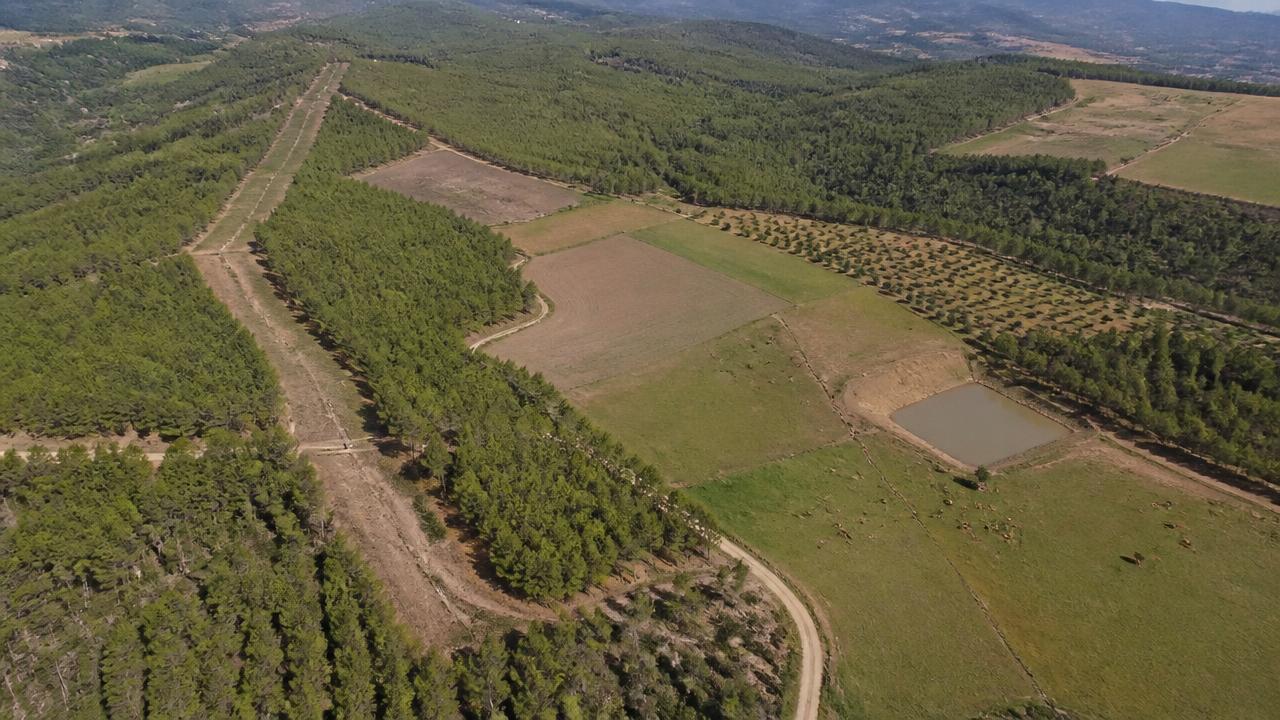
- Interspersed crops, pastures and meadows
- Discontinuities and silviculturally treated areas
- Maintained accesses and water points
- Managed extensive livestock farming and silvopastoralism
Labels describe each landscape with text; readability does not depend on color. Prescribed burns are only considered under planning and execution by a competent service.
What it demonstrates — and what it does not
What it demonstrates
That the landscape structure —continuity versus discontinuity— conditions the propagation and maneuverability opportunities for extinction resources.
What it does not demonstrate
It does not prove that a mosaic prevents all fires, it does not quantify the reduction in affected area, and it is not equivalent to “clearing the forest” by devastating vegetation.
- Source
- MITECO, Strategic guidelines for forest fire management; MITECO, preventive actions in low-risk areas (BLP).
- Editorial date
- Web edition v2.0 · August 4, 2026
- Level of evidence
- B
Alternative text: Didactic comparison of two landscapes: on the left, a hillside with continuous vegetation without interruptions or maintained accesses; on the right, the same hillside with crops, pastures, treated areas, tracks, and a water point that create discontinuities.
V5 · Auditable visual
The interface is not just a line
Message: The wildland-urban interface is a strip with vegetation, plots, accesses, water, evacuation, and structures, not a boundary drawn on a map.
Band 1
Monte
Continuous forest mass, accumulated fuel, slope and local winds.
Band 2
Franja de transición
Treated vegetation, discontinuities, firebreaks and maintained perimeter roads.
Band 3
Parcelas e interfaz
Hedges, woodpiles, ornamental trees and combustible materials next to the fence.
Band 4
Estructuras
Roofs, openings, eaves and enclosures; structure defense and self-protection.
- Accesses
- Width, firm ground and double exit for resource entry and resident exit.
- Water points and hydrants
- Registered, signposted, accessible and verified.
- Evacuation
- Alternative routes, public warnings and defined meeting points.
- Structure defense
- Declared priorities, sectors and resource allocation.
What it demonstrates — and what it does not
What it demonstrates
That interface protection depends on several linked bands and verifiable elements: access, water, evacuation and structure preparation.
What it does not demonstrate
It does not set specific widths, distances or requirements, which correspond to regional regulations and the applicable planning in each municipality.
- Source
- MITECO, Strategic guidelines for forest fire management; Law 43/2003 on Forests and regional self-protection regulations referred to in the Guidelines.
- Editorial date
- Web edition v2.0 · August 4, 2026
- Level of evidence
- B
Alternative text: Diagram in four bands from the forest to the structures: forest with continuous mass, treated transition strip, interface plots with ornamental vegetation and built structures; on the diagram, accesses, water points and hydrants, evacuation routes and structure defense are indicated.
V11 · Auditable visual
Twelve months of prevention
Message: Prevention is an annual cycle with distinct and linked tasks; the extinguishing campaign is only one of its phases.
| Task | Window | Content |
|---|---|---|
| Planning and budget | Before the annual cycle | Multi-year programming, contracts and objectives by region. |
| Silvicultural works | Low danger period | Thinning, selective clearing and residue treatment. |
| Grazing and silvopasture | According to pasture cycle | Agreed livestock load and results monitoring. |
| Prescribed burns | Authorized windows | Only with planning, prescription and execution by competent service. |
| Maintenance of access roads, ditches and water | Full cycle, with pre-campaign review | Firebreaks, tracks, signage and verification of water points. |
| Training and accreditation | Out of campaign, with refreshers | Competencies by specialty and accreditation registry. |
| Drills and coordination | Before campaign | Interoperability, communications and joint command. |
| High danger campaign | As per declaration of each autonomous community | Seasonal reinforcement, rotations, and uncommitted reserve. |
| Evaluation and lessons learned | At the end of the cycle | Results audit and correction of subsequent planning. |
Adapt to the territory: windows are not homogeneous throughout Spain.
What it demonstrates — and what it does not
What it demonstrates
That there are differentiated preventive tasks throughout the annual cycle and that their execution does not coincide with the period of greatest danger.
What it does not demonstrate
It does not set identical months for all of Spain: the windows depend on the climate, vegetation, regional regulations, and the campaign declaration of each community.
- Source
- MITECO, Strategic guidelines for forest fire management; MITECO, preventive actions BLP.
- Editorial date
- Web edition v2.0 · August 4, 2026
- Level of evidence
- B
Alternative text: Annual prevention calendar in nine rows: planning and budget, silvicultural works, grazing and silvopasture, prescribed burns, access and water maintenance, training, drills, high danger campaign, and evaluation; each row indicates its time window and the warning to adapt the calendar to the territory.
Chapter 03 close
If the territory determines the initial conditions, the response depends on who decides what during the incident and with what accredited competence.
Continued on 04 · Mando y especialización
04 · Command and Specialisation
Coordinating is not commanding; commanding requires competence
In an emergency, three planes coexist that should not be mixed: political and administrative leadership, which is accountable to the public and activates the legal framework; plan direction, which sets protection objectives and mobilizes resources; and operational command of the incident, which converts those objectives into strategy, tactics, and safety on the ground. The National Civil Protection System (Law 17/2015) (external link, opens in a new tab) articulates this distribution of functions.
The practical consequence is simple: intervention leadership must fall to whoever has accredited technical competence to direct the manoeuvre, with command support teams —fire analysis, meteorology, cartography, safety, logistics, and information— that underpin the decision. Coordinating tables and bodies is essential, but it is not equivalent to tactically directing a fire.
This report does not evaluate individuals. Pointing out that a function requires technical competence is not attributing personal incompetence to anyone, nor is it stating that a legal qualification alone incapacitates someone from performing a role: what is required is that the capacity be accredited and verifiable. (civil protection personnel framework, Royal Decree 1755/2007) (external link, opens in a new tab).
The second piece is specialization. Forest firefighter, urban, interface, industrial, airport, naval or nuclear are not interchangeable categories: the mission, training, equipment, risks and limits change. State and regional authorities publish which resources and units they deploy (MITECO, ground resources and BRIF) (external link, opens in a new tab), and the pending step is to classify each unit by accredited capabilities, not by the uniform it wears or the administration it depends on.
Editorial review
A system that adds units without declaring their accredited capabilities confuses volume with operational capacity.
Visual family for chapter 04
Two visuals: the distribution of decision functions (V6) and the matrix of specialties and operational limits (V7).
V6 · Auditable visual
Who decides what
Message: Plan direction, operational command, and sector execution are distinct functions; coordinating is not equivalent to commanding.
- 1
Autoridad y dirección del plan
Sets public protection objectives, activates the plan, declares situations and decides on evacuations and extraordinary resources.
- 2
Mando operativo del incidente
Translates objectives into strategy and tactics, organizes sectors and is responsible for the safety of the intervention.
- 3
Jefaturas de sector o foco
Execute the assigned tactics in their section, with common criteria and communication with command.
- 4
Información y evidencia
Provides analysis, cartography, meteorology and monitoring; supports decision-making, does not replace it.
Risk noted: confusing coordination with command leaves the incident without a single technical line of tactical decision-making.
What it demonstrates — and what it does not
What it demonstrates
That the civil protection framework distinguishes plan direction from operational incident command and sector-based execution.
What it does not demonstrate
Does not evaluate the performance of specific individuals, does not attribute personal incompetence and does not imply that a legal title alone incapacitates for a function.
- Source
- Law 17/2015 of the National Civil Protection System; Royal Decree 1755/2007 on personnel of the General Directorate of Civil Protection and Emergencies; MITECO, Strategic guidelines.
- Editorial date
- Web edition v2.0 · August 4, 2026
- Level of evidence
- A
Alternative text: Diagram of four linked functions: plan authority and direction set public protection objectives; operational command defines strategy, tactics and safety; sector or focus commands execute; information and evidence provide support. A final warning advises against confusing coordination with command.
V7 · Auditable visual
Specialties that are not replaced
Message: Each unit must be classified by accredited capabilities, not by uniform or administrative dependency.
| Unit | Main mission | Accreditable training and equipment | Operational limit |
|---|---|---|---|
| Forest firefighters | Forest fire attack and control, maneuvers in the wildland and prescribed burning for containment. | Training in fire behavior, wildland safety, manual tools, and work with aerial means. | Does not replace structural intervention or response to industrial risk. |
| Wildland-urban interface | Defense of structures and protection of population in the wildland-urban interface. | Mixed wildland and structural competence, self-protection, and evacuation. | Requires dual accreditation; it cannot be resolved by assigning a unit that is only wildland or only urban. |
| Urban firefighters | Structural fire, rescue, and urban emergencies. | Ventilation, interior extinction, rescue at height, and in vehicles. | Structural tactics are not directly transferable to wildland with slope and wind. |
| Company and industrial firefighters | Process risk, chemical product, and facility protection. | Foam agents, chemical risk, and establishment self-protection plans. | Scope tied to their facility and their plan. |
| Airport rescue and firefighting service | Intervention in aircraft accidents and protection of the airport premises. | Regulated response times, specific agents, and high-capacity vehicles. | Availability conditioned by their permanent airport mission. |
| Logistical support and accredited volunteering | Logistics, evacuation, communications, population support, and standby teams. | Accredited training, PPE, communications, insurance, and written agreement. | It does not automatically count as a direct attack on the fire. |
What it demonstrates — and what it does not
What it demonstrates
That there are missions, training and equipment differentiated by specialty and that operational fit depends on accreditable capabilities.
What it does not demonstrate
It does not set minimum training durations or curricular content, which depend on each competent administration, and does not hierarchize the professional value of the units.
- Source
- Law 17/2015 of the National Civil Protection System; MITECO, Strategic guidelines; MITECO, terrestrial means and BRIF.
- Editorial date
- Web edition v2.0 · August 4, 2026
- Level of evidence
- B
Alternative text: Matrix of six types of units —forest, interface, urban, industrial, airport and accredited logistics support or volunteering— with their main mission, accredited training and equipment, and declared operational limit.
Chapter 04 closing
If command demands accredited competence, the public conversation demands something equivalent: knowing what the resource figures announced each campaign truly mean.
Continued on 05 · Lo que cuentan los titulares