
Report index
Strategic Report · Southern border
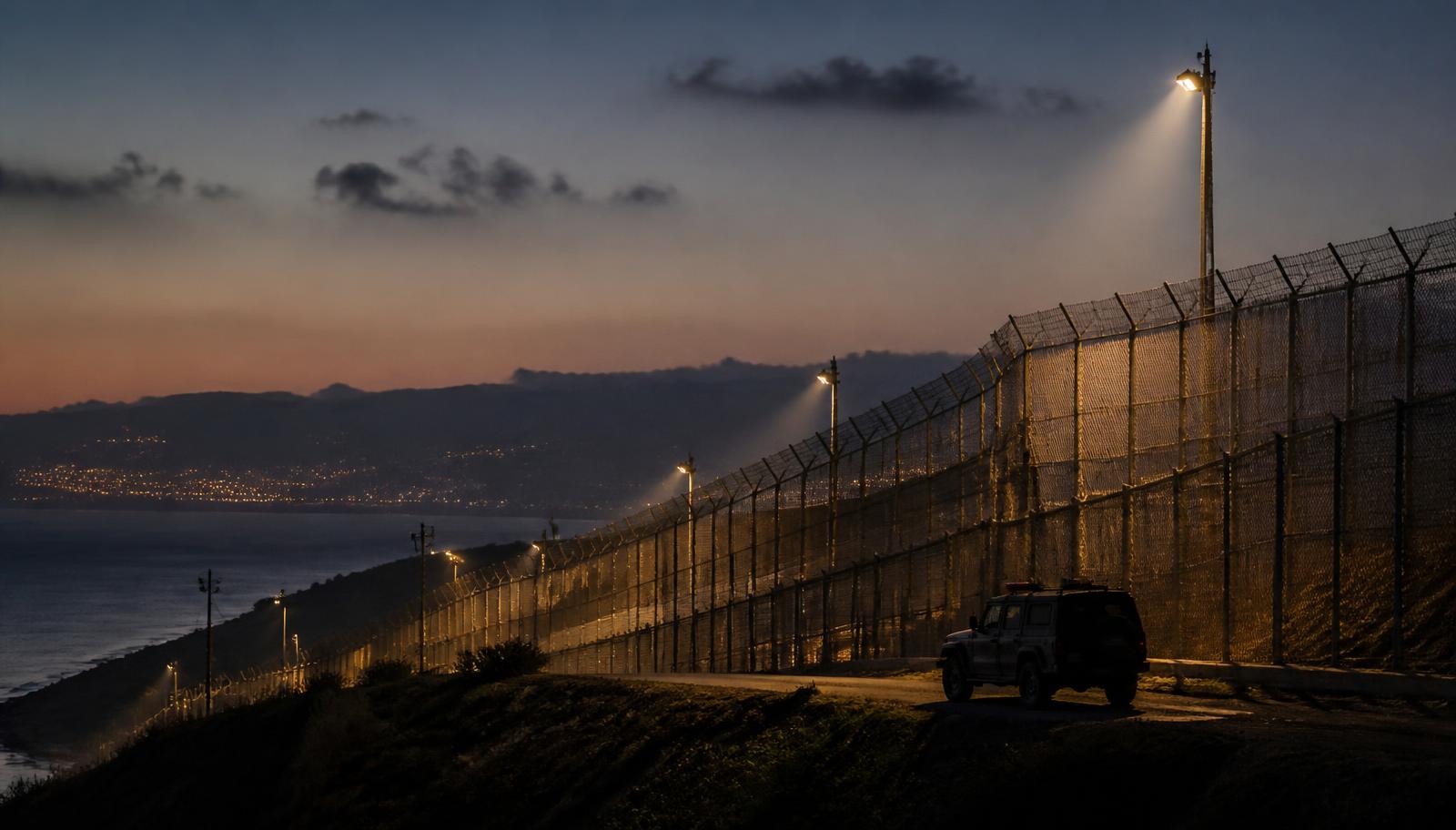
The Ceuta and Melilla fence
The fence won its direct battle; the problem shifted to the sea, to the outsourcing of control, and to the political instrumentalization of the border.
Historical basis, current situation, legal framework, intelligence dimension and geopolitical chessboard, from 1971 to the open crisis of July-August 2026. Analysis document written in accessible language for political decision-makers. Disputed figures are presented with a range and source for each extreme. The data for the July-August 2026 crisis are provisional and are being counted.
- Code
- SSRC-RED-CM-01Version VER1_0 · open to networks
- Chapters
- 14Nine chapters and five extensions
- Cut-off date
- 06.08.20262026 data under recount
- Scope
- 1971-2026Physical border and geopolitical vector
- Owner
- Mr. José Antonio Amador Pérez · SS&RC Directorate
- Recipient
- Intelligence service and political decision-makers
- Status
- For review · full content
Executive Summary
Executive Summary for Decision-Makers
This report examines the Ceuta and Melilla fence as a physical border and a geopolitical vector, from 1971 to the open crisis of July-August 2026. Its ten main tenets:
- The 2026 fence-sea paradox. The 10-meter fence won its direct battle —residual massive jumps since 2022— but displaced the flow to swimming, where lethality is higher: 46 deaths in 2025 (police sources) and 99 in 2026 (EFE, 1/08/2026).
- The legal-operational vacuum. The Supreme Court judgment (STS) 814/2026 excluded the sea from "border rejection" and detonated the July 2026 crisis: a range of 40,000 to 72,000 entries and 67 confirmed deaths on the Spanish side, figures still being tallied.
- Four tragic milestones, structural impunity. 2005 (14-15 dead), Tarajal 2014 (14-15 drowned), Melilla 24J 2022 (23 according to official figures; 27-37 according to NGOs; possibly over 100 according to Amnesty International, June 2023; impunity intact on the fourth anniversary) and July 2026, still open.
- Pressure does not decrease: it changes route. Land border +45.4% in 2025 and +140% in 2026, with the national total at -42.6% and the Canary Islands at -62% (Ministry of Interior, 2025-2026); Ceuta is the leading indicator of the system.
- Eleven years of law without development. Border rejection, legal since Organic Law (LO) 4/2015, never had regulatory development; its legitimacy is conditioned (European Court of Human Rights, ECHR, 2020; Constitutional Court judgment, STC, 172/2020) on legal channels that the Moroccan police filter de facto undermines; the Provincial Court (AP) of Cádiz condemned the former delegate in Ceuta in 2025.
- The new European landscape. The European Pact on Migration and Asylum (PEMA), applicable since 12/06/2026: mandatory border procedure, fiction of non-entry and Crisis and Instrumentalisation Regulation (2024/1359).
- Actual control is externalized. Morocco is a subcontracted gendarme (500 M€ from the EU, 2021-2027) and a shareholder in the stopcock: its deliberate relaxations in 2021 and 2026 acted as pressure.
- The border as an infiltration vector. Avalanches nullify biometric tagging and inject assets: agents from the General Directorate of Studies and Documentation (DGED) among the swimmers in 2021, a pattern repeated in 2026; Moroccan espionage, second most aggressive after Russian, relies on Pegasus and the corruption of the State Security Forces and Corps (FCSE) (Operation Hades, 2025).
- Sovereignist pressure without weapons. The Alawi claim remains active but, after Perejil 2002, is exercised through hybrid warfare; structural asymmetry favours Rabat —chokepoint, Washington's backing, informational advantage— and its brakes expire with the 2030 World Cup.
- The probable scenario is recurring crisis. Scenario B —cyclical crisis instrumentalised by Rabat— concentrates 40-50% of the estimated probability; the discriminating variable is political, not technical, and Italy's suspension of Schengen with Spain in 2026 evidences the European systemic risk.
Conclusions for the intelligence service
First, treat every avalanche as a potential injection of assets. The evidence from 2021 (DGED disguised among swimmers) and 2026 (passivity of the Moroccan deployment) demands that this be assumed as adversarial doctrine: the benefit is anticipating screening; the cost, a post-entry biometric capability that is currently non-existent on that scale.
Second, monitor prior indicators of the chokepoint. Customs, sovereign rhetoric, police deployments in Nador and Fnideq, and signals from the Rabat-Washington axis offer more reliable early warning than the perimeter itself, which only detects a crisis once it has begun.
Third, close internal vulnerabilities. Pegasus compromised communications of border authorities and the Tarajal narco-tunnel demonstrates that the weak link is not technical but human: cryptographic hygiene and auditing of critical personnel offer immediate return at limited cost.
Conclusions for political decision-making
First, provide border rejection with the regulatory development pending since 2015, adapted to STS 814/2026 and the PEMA. The benefit is legal certainty for agents and authorities, currently exposed to criminal liability; the cost, difficult parliamentary negotiation and scrutiny from Strasbourg.
Second, reduce dependence on the subcontracted gendarme. As long as effective control resides in Rabat, any Spanish concession is reversible; diversifying cooperation with countries of origin and making legal asylum routes real reduces blackmail, although in the short term it may increase pressure.
Third, reorient investment towards the sea. More than €100 M in fences and €541 M in technology (2018-2025) protected the land while the lethal flow shifted to the Strait; maritime surveillance and rescue save lives and comply with the Supreme Court's mandate, with budgetary cost and a debated pull factor effect.
Looking to 2030, the decisive variable will not be technical but political: no protective measure will solve a border whose physical chokepoint is in Rabat. The shared World Cup curbs the temptation of Moroccan chaos and the PEMA offers unprecedented European levers; the window to renegotiate the architecture of the southern border is now, before those brakes expire.
Report Map
Six navigable parts
The report is read in parts to avoid a single endless page. The content is complete: no section has been summarized or suppressed.
- Part IHistorical basis and genesis of the fenceSovereignty, Moroccan claim, and construction of the perimeter from 1971 to 20220102IV1
- Part IIChronology of crises and current situation2005, Tarajal 2014, Melilla 24J 2022, Ceuta 2026 and the fence today03IV204
- Part IIILegal framework, immigration, and European fundsBorder rejections, STS 814/2026, 2025 regulation and the 179 million from the EU0505b05tIV4
- Part IVIntelligence, Strait and geopolitical boardCNI-DGED showdown, China on both shores, Rota and Morón, 2030 World Cup0606b07IV307b
- Part VRisks, 2026-2030 scenarios and conclusionsRisk matrix, the possible second jump of the 15th, prospective scenarios and analytical closure0808b09
- Part VISources and ReferencesCited documentation, levels of evidence, and methodological noteF